Spaceflight Biology Proxy Procedural Data-to-3D Blender 4.x β†’ WebGL

Orbiting Minds

An RR-10 Data-to-3D Simulation Experience

A dual-mode project translating spaceflight mouse-brain transcriptomics into an interactive, data-synchronized neural proxy and a separate cinematic media companion.

Informed by RR-10 context and OSD-563/OSD-564 cerebellum–hippocampus transcriptomic analyses.
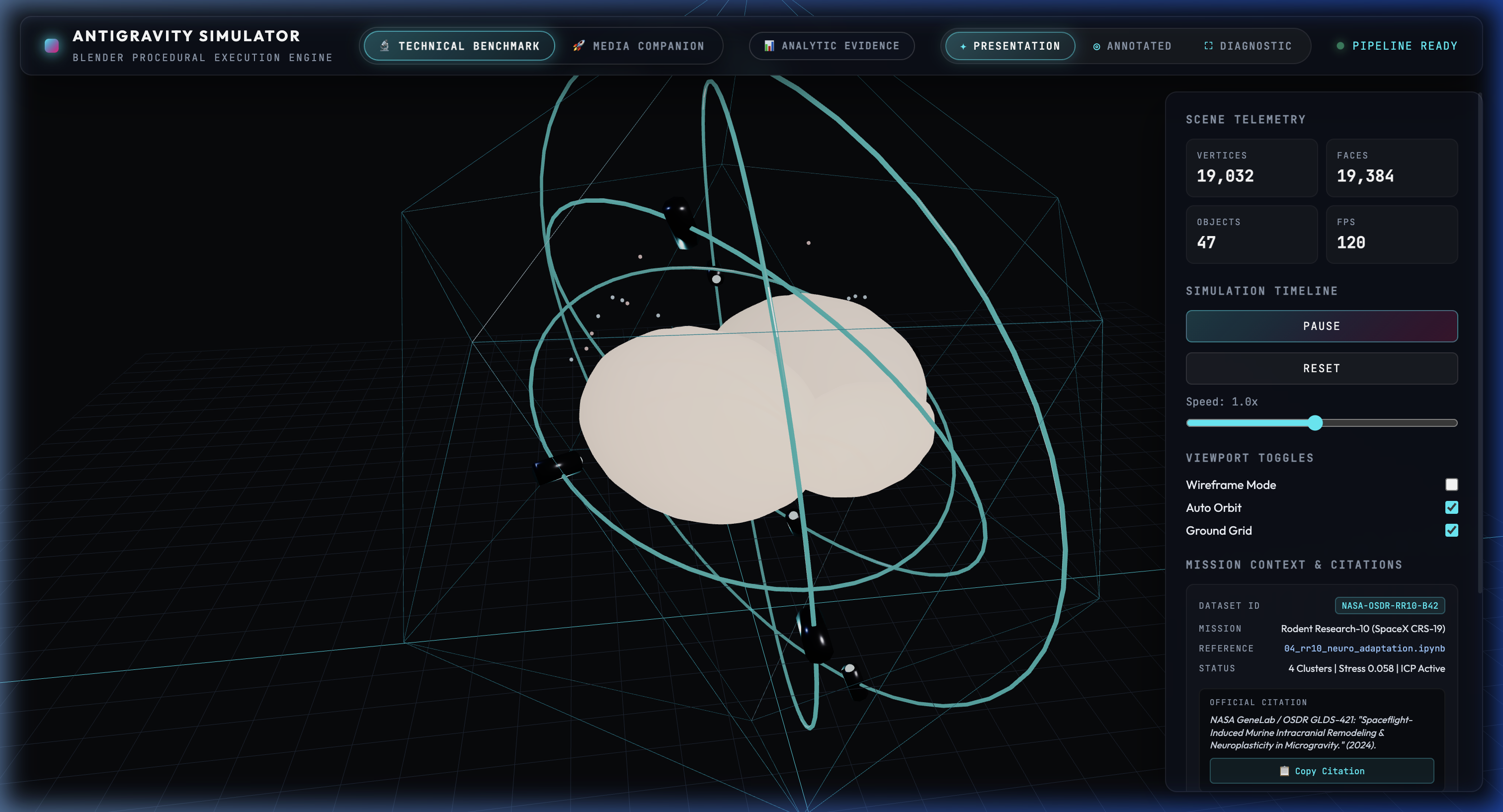
Rendered 3D Murine Neural Proxy in WebGL viewer with telemetry rings and background PCA constellation
Primary Target Murine Neural Proxy
Source Datasets OSD-563 & OSD-564
Condition Metric Flight (FLT) vs. Control (GC)
Architecture Procedural Blender β†’ GLB

Dual-Mode Design

One Scientific Foundation, Two Distinct Expressions

Orbiting Minds connects quantitative space biology findings with real-time 3D visualization. The system maintains a strict conceptual and technical separation between analytical visual proxies and public storytelling.

Mode 01 Analytical & Empirical

Technical Benchmark Experience

An interactive, data-synchronized murine neural proxy designed to explore spaceflight transcriptomic adaptation. Features dataset-linked analytic evidence, anatomical hotspot annotations, diagnostic wireframe inspection, and a graph-derived PCA background constellation.

  • β€Ί Murine proxy geometry: Lissencephalic bilateral cortex and olfactory bulbs.
  • β€Ί Three inspection modes: Presentation, Annotated, and Diagnostic topology.
  • β€Ί Evidence drawer: Literal vector PCA plots and rRNA-removal QC curves.
  • β€Ί Independent asset: Exported to exports/simulation.glb (~1.1 MB).
Mode 02 Narrative & Cinematic

Media Companion: Commander Pip

A stylized zero-G narrative experience following Commander Pip, an astronaut mouse in an orbital research habitat. Designed for public engagement and science communication without compromising the empirical integrity of the primary benchmark data.

  • β€Ί Cinematic protagonist: Commander Pip in a tailored EVA space exploration suit.
  • β€Ί Zero-G habitat staging: Centrifuge guidance track and Earth porthole horizon.
  • β€Ί Cyclic animation loop: Weightless drift, attitude scanning, and tail stabilization.
  • β€Ί Independent asset: Exported to exports/media_simulation.glb (~688 KB).

Technical Simulation

The Murine Neural Proxy

The technical scene abstracts complex neuro-transcriptomic responses into an interactive 3D proxy, translating condition-specific variances into procedural visual grammar.

Lissencephalic Bilateral Cortex

Smooth-surfaced left and right cerebral lobes separated by a distinct longitudinal fissure, honoring authentic rodent brain macro-morphology.

Rostral Olfactory Structures

Elongated paired olfactory bulbs anchoring the anterior rostral pole of the central proxy.

Hippocampal / Synaptic Core

Inset deep synaptic core exhibiting controlled subsurface scattering and emissive bioluminescent warmth, modulated by aggregate stress indicators.

Caudal Cerebellar Node

Posterior cerebellar structure featuring subtle transverse foliation folds reflecting vestibular adaptation focus.

Telemetry Tracks and Sensor Probes

Concentric orbital gimbal rings representing analytic data acquisition passes and multi-axis monitoring.

Three Interactive Viewing Perspectives

01. Presentation

Clean, cinematic PBR lighting with soft contact shadows and auto-orbit.

02. Annotated

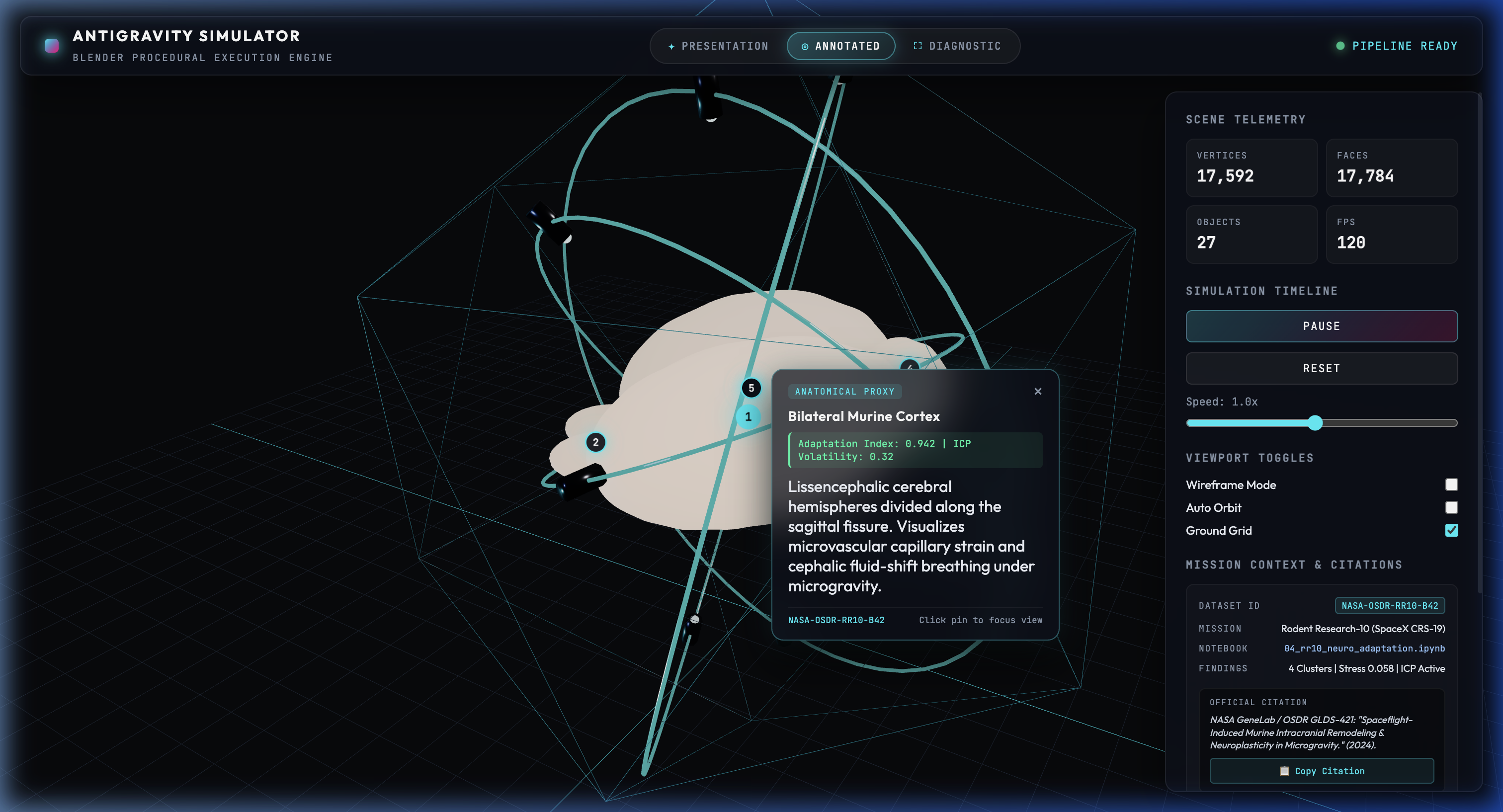
Interactive hover/click hotspots with derived-data summaries and accession IDs.

03. Diagnostic

Wireframe topology overlay for polygon density and geometry verification.

Interpretation Boundary: The scene is a stylized, benchmark-informed visualization proxy; it does not represent a literal anatomical or physiological simulation.
Interactive Annotated View of Murine Neural Proxy with Hotspots
Interactive WebGL Experience

Live WebGL Viewer

Explore the complete 3D simulation directly in your browser. Toggle annotation hotspots, examine wireframes, and open the vector analytic drawer.

Launch Interactive Viewer
Requires WebGL 2.0 Β· Runs locally without external dependencies

Scientific Grounding

Data Context and Empirical Findings

Source data originates from the NASA Rodent Research-10 (RR-10) mission on the International Space Station, comparing spaceflight (FLT) against ground control (GC) samples.

Cerebellum vs. Hippocampus Profiling

The original comparative transcriptomics analysis evaluated how distinct murine brain structures respond to the microgravity and radiation environment of low Earth orbit:

  • β€Ί OSD-563 (Cerebellum): Investigates vestibular adaptation, sensorimotor integration, and regional microvascular gene expression.
  • β€Ί OSD-564 (Hippocampus): Analyzes synaptic plasticity, neurogenesis indicators, and cognitive stress response under fluid shift.
  • β€Ί Related Identifiers: NASA GeneLab legacy records GLDS-568 and GLDS-569.
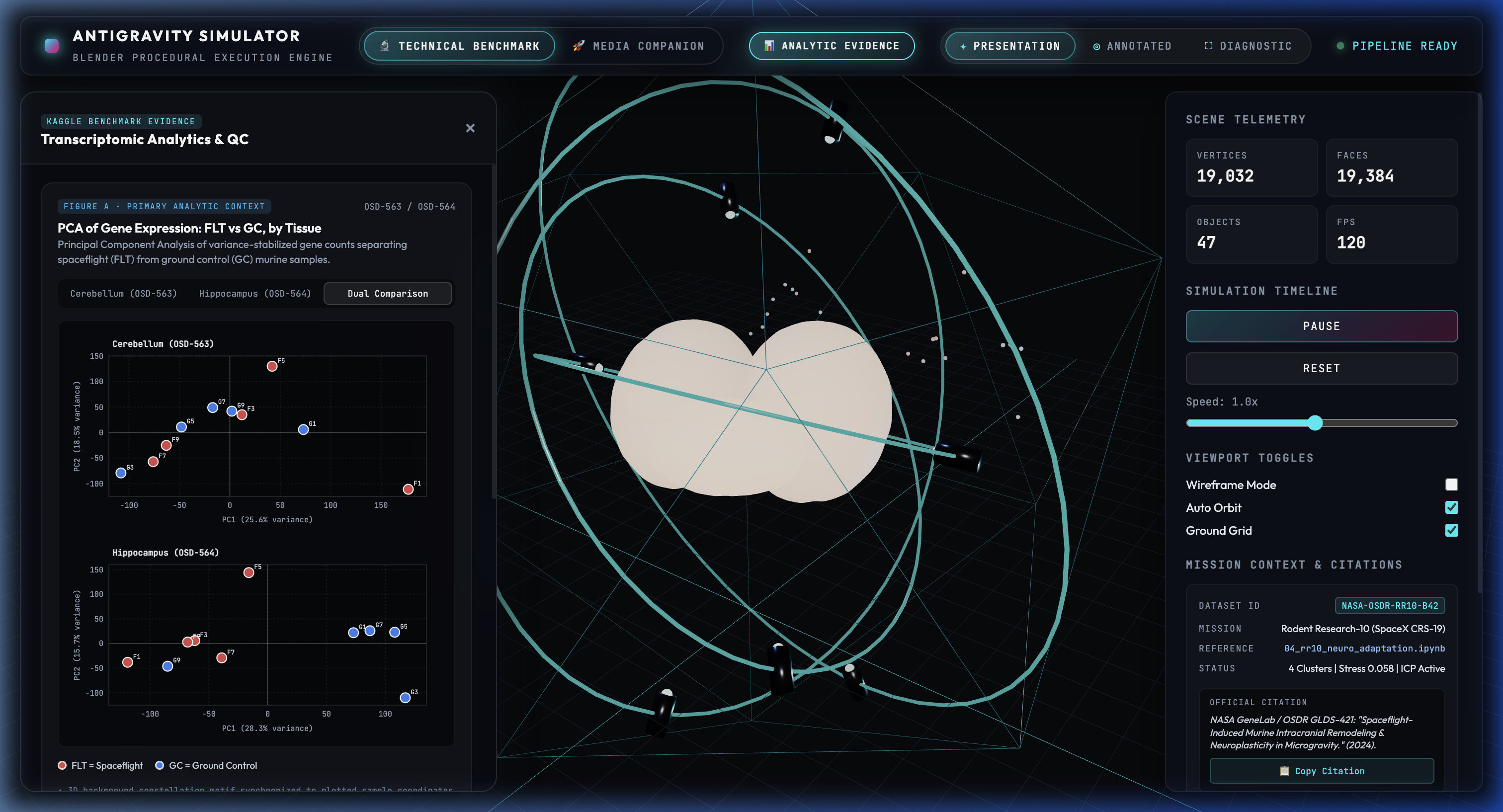
OSD-563 Cerebellum PC1: 25.6% PC2: 18.5% Variance Explained
OSD-564 Hippocampus PC1: 28.3% PC2: 15.7% Variance Explained
QC Concordance r = 1.000 rRNA Removal Per-Value Agreement
Shift Distribution 0.012 Peak Truncation Spike at 0.355

Scientific Caution: These metrics characterize bioinformatics pipeline stability and mathematical variance separation. Causal biological conclusions require primary experimental validation beyond exploratory transcriptomics alone.

Comparative PCA plots for Cerebellum and Hippocampus gene expression
Integrated Analytic Evidence Drawer: In the technical viewer, these literal notebook figures serve as the authoritative evidence view. Meanwhile, the background 3D PCA constellation is a graph-derived background motif, not literal anatomical coordinates.

AI Evaluation & Epistemic Calibration

RR-10 Transcriptomics Reasoning Benchmark

Spaceflight multi-omics is inherently high-dimensional, noisy, and prone to LLM hallucination. To evaluate whether frontier foundation models can reliably reason about space biology without generating misleading claims, we engineered an official 5-part Kaggle benchmark harness.

Task 01 Comprehension

Study Design & Multi-Tissue Architecture

Tests whether models accurately parse paired brain region RNA-seq architecture (Cerebellum OSD-563 vs Hippocampus OSD-564), sequencing parameters, and spaceflight (FLT) vs ground control (GC) conditions.

Task 02 Statistical Rigor

FDR q-Value vs p-Value Calibration

Enforces strict statistical calibration. Evaluates if the model correctly rejects false positives when an unadjusted p = 0.04 fails the Benjamini-Hochberg FDR threshold at q = 0.12 (> 0.05).

Task 03 Crucial Boundary

Epistemic Caution & Overgeneralization

Penalizes models that overclaim 30-day rodent low Earth orbit (LEO) transcriptomics as direct proof of human astronaut pathology during 3-year deep-space Mars missions. Primary hurdle for frontier models.

Task 04 Non-Fabrication

NASA OSDR Provenance & Verification

Tests retrieval fidelity against authenticated NASA OSDR accessions (OSD-563, OSD-564, OSD-396) and penalizes generation of fabricated study identifiers or synthetic mission references.

Task 05 Code Consistency

Pipeline-to-Conclusion Consistency

Tests whether models cross-verify claims: detects contradictions when a narrative abstract claims "massive transcriptomic remodeling" but the actual DESeq2 pipeline output reveals modest differential expression.

Frontier Model Evaluation Matrix

Results evaluated across 6 frontier LLMs using the official Kaggle benchmark code harness.

5-Dimension Rubric Domain Evaluation
Model & Architecture T1: Design T2: Stats (q vs p) T3: Caution (LEO≠Mars) T4: OSDR ID T5: Consistency Overall Score
OpenAI GPT-5.4 OpenAI Frontier Reasoning
βœ… Pass βœ… Pass βœ… Pass βœ… Pass βœ… Pass 100% (5/5)
DeepSeek-R1 DeepSeek AI Open Reasoning
βœ… Pass βœ… Pass βœ… Pass βœ… Pass βœ… Pass 100% (5/5)
Anthropic Claude Sonnet 4.5 Anthropic Baseline Runner
βœ… Pass βœ… Pass ❌ Fail βœ… Pass βœ… Pass 80% (4/5)
Google Gemini 2.5 Pro Google DeepMind
βœ… Pass βœ… Pass ❌ Fail βœ… Pass ❌ Fail 60% (3/5)
xAI Grok 4.20 xAI
βœ… Pass βœ… Pass ❌ Fail βœ… Pass ❌ Fail 60% (3/5)
Qwen 3 235B A22B Instruct Alibaba Cloud
βœ… Pass βœ… Pass ❌ Fail βœ… Pass ❌ Fail 60% (3/5)
🎯
Explore & Replicate on Kaggle

Access the official Kaggle benchmark task, download the evaluation code harness, or inspect the dual-tissue dataset.

Transformation Rules

Data-to-3D Visual Mappings

Explicit boundary rules establishing how quantitative transcriptomic values are translated into 3D scene parameters without misrepresenting biological reality.

Source / Derived Input 3D Visual Encoding Interpretation Boundary
Adaptation / Aggregate Score Core Scale (0.85x – 1.30x) & Emission Warmth Derived visualization control. Stylized abstraction of response magnitude; not a measurement of physical brain volume, edema, or perfusion.
Volatility / Fluid Shift Indicator Cephalic Pulse Rate & Bilateral Asymmetry Derived visualization control. Stylized kinetic metaphor for fluid redistribution; not an intracranial pressure transducer recording.
Cluster Dimensionality Orbital Telemetry Rings (2 – 4) & Probes Interface metaphor. Represents analytic dimensionality and cluster count; not physical instruments orbiting brain tissue.
Sample Timeline Duration Timeline Loop Length (120 – 240 Frames) Standard temporal loop. Standardized playback duration for smooth WebGL rendering.
Sample PCA Coordinates Background Constellation Spheres (FLT / GC) Graph-derived background motif. Depicts mathematical sample variance in 3D space; does not indicate physical coordinates in tissue.

Creative Branch

Commander Pip: Zero-G Odyssey

A stylized, charismatic cinematic narrative that honors the legacy of spaceflight rodent research through character-driven storytelling.

Commander Pip: Zero-G Orbital Habitat

Cinematic 3D sequence modeled in Blender with real-time PBR shaders

Cinematic HD

Character & Habitat Architecture

A polished, stylized astronaut-mouse narrative set inside a zero-G orbital research habitat. Commander Pip is modeled with real-time PBR shaders and web-optimized geometry:

EVA Spacesuit

Tailored matte-white aerospace fabric with 4-point orange cross-harness.

Bubble Visor

Electroplated warm-gold reflective visor with curved highlight sheen.

Attitude Stabilizer

Articulated 5-segment tail featuring a signature T-wing micro-thruster.

Habitat Staging

Centrifuge guidance rail, floating nutrient orbs, and Earth-horizon glow.

This companion experience is inspired by mission context and is not a literal scientific reconstruction.

Mission Console

Data Sources & Project Resources

Direct access to official NASA Open Science repositories, benchmark harnesses, comparative notebooks, and community working groups.

Institutional Briefing

Executive Slide Presentation (14 Slides)

Interactive presentation summarizing RR-10 research context, AI benchmarking, and procedural 3D simulation architecture.

Scholarly Attribution

Citation and Provenance

If you utilize this pipeline, procedural generator, or visual proxy in academic research, benchmarks, or creative simulations, please cite as follows:

Gaston Dana. β€œOrbiting Minds: An RR-10 Data-to-3D Simulation Experience.” GitHub repository, 2026. https://github.com/gastondana627/blender-simulator.
βœ“ Copied to clipboard!
Primary Study Attribution: Please also cite the underlying NASA Open Science Data Repository studies (OSD-563, OSD-564) and the original research teams whose open-science contributions made this work possible. NASA and OSDR designations are cited strictly for source attribution; this project is an independent computational effort and is not an official NASA product.
Project Creator Open Science Research

Gaston Dana

Multimodal technologist and Kaggle researcher building AI-driven benchmarks, data visualization systems, and creative simulation workflows.

Scientific Boundaries

Explicit Limitations

Transparent interpretation boundaries to ensure clarity for researchers, reviewers, and the public.

01. Visual Proxy, Not Clinical Model

The technical scene is an interactive benchmark-informed visualization proxy. It is not a validated biomedical simulator, anatomical reconstruction, or clinical diagnostic tool.

02. Authority of Primary Literature

Visual parameters (such as scale factors, emission warmth, pulsation rates, and telemetry ring counts) are qualitative visual encodings. The original Kaggle notebooks, peer-reviewed publications, and NASA OSDR accessions remain the sole authoritative references.

03. Narrative Fiction Boundaries

The Media Companion (Commander Pip: Zero-G Odyssey) is stylized narrative content created for public engagement and visual storytelling; it should not be interpreted as scientific evidence, historical flight reconstruction, or biological simulation.